Kidney Stone Treatment in Howrah: Causes, Symptoms and Complete Care Guide
A sudden, sharp pain in the side that comes in waves and leaves you doubled up. Pain that spreads to the lower belly and groin. Blood in the urine. For thousands of people in Howrah and Kolkata, this is the first sign of a kidney stone.
Kidney stones are very common in India. Hot weather, less water intake, salty food, and long working hours without enough fluids all raise the risk. The good news is that most stones can be treated without major surgery. Small stones often pass out on their own, and larger ones can be broken with sound waves or laser through modern day-care procedures.
This guide explains everything in simple words: what kidney stones are, why they form, the symptoms to watch for, how doctors find them, all the treatment options from medicines to laser surgery, the food habits that prevent them, and where to get proper kidney stone care in Howrah.
Table of Contents
- What Are Kidney Stones?
- Types of Kidney Stones
- Causes and Risk Factors
- Symptoms You Should Not Ignore
- How Are Kidney Stones Diagnosed?
- Kidney Stone Treatment: What Are the Options?
- Which Treatment Suits Your Stone?
- Diet Guide to Prevent Kidney Stones (Bengali Food Included)
- What Happens If Kidney Stones Are Ignored?
- Kidney Stone Care at Lords Health Care, Howrah
- Frequently Asked Questions
What Are Kidney Stones?
Your kidneys filter your blood and make urine. When urine becomes too concentrated, minerals and salts in it can join together and form hard deposits. These are kidney stones.
A stone can be as small as a grain of sand or as large as a golf ball. Tiny stones often pass out with urine without you ever noticing. Problems start when a stone is big enough to get stuck in the kidney or in the ureter, the thin tube that carries urine from the kidney to the bladder. A stuck stone blocks urine flow, and that blockage causes the severe pain kidney stones are famous for.
Anyone can get a kidney stone, but they are most common in adults between 30 and 60, and men get them slightly more often than women.
Types of Kidney Stones
Not all stones are the same. Knowing the type helps the doctor plan long-term prevention:
- Calcium oxalate stones: the most common type, about 8 out of 10 stones. They form when calcium joins with oxalate, a substance found in many foods.
- Calcium phosphate stones: form when urine is less acidic than normal.
- Uric acid stones: more likely if you eat a lot of meat or have gout.
- Struvite stones: form after repeated urinary tract infections and can grow large quickly.
- Cystine stones: rare, and they run in families.
If you pass a stone, your doctor may ask you to save it for testing. The test result guides the diet and medicines that will stop the next stone from forming.
Causes and Risk Factors
Stones form when urine has too much stone-forming material and too little water to keep it dissolved:
- Not drinking enough water. This is the biggest reason. In Howrah's heat, outdoor workers, drivers, and shopkeepers often go hours without water.
- Too much salt in food. Extra salt raises calcium in the urine, which feeds stone formation.
- Too much animal protein. Large amounts of meat raise uric acid and lower the urine's protection against stones.
- Oxalate-rich foods in excess. Palong shaak (spinach), nuts, and chocolate are healthy foods, but in very large amounts they add oxalate for people prone to calcium oxalate stones.
- Being overweight. Obesity changes urine chemistry in ways that favour stones.
- Family history. If your parents or siblings had stones, your risk is higher.
- Repeated urinary infections. These can lead to struvite stones.
- Gout and some medicines. These raise uric acid or calcium levels.
- Dark yellow urine most days. This is your body's simplest warning that you are not drinking enough water.
Symptoms You Should Not Ignore
Small stones sitting quietly in the kidney may cause no symptoms at all. Symptoms begin when a stone starts moving or blocks urine flow:
- Sudden, severe pain in the side or back, below the ribs, often coming in waves
- Pain spreading to the lower abdomen and groin
- Burning or sharp pain while urinating
- Urine that looks pink, red, or brown (blood in the urine)
- Cloudy or foul-smelling urine
- Needing to urinate more often, or passing only small amounts
- Nausea and vomiting along with the pain
- Fever and chills with flank pain. This is an emergency. It can mean infection behind a blocked stone, which needs urgent hospital care. Do not wait at home.
The classic kidney stone pain is often described as one of the worst pains a person can feel. If painkillers do not control it, go to a hospital.
How Are Kidney Stones Diagnosed?
Diagnosis is straightforward and usually takes a day:
- Urine test: checks for blood, infection, and crystals in the urine.
- Blood test: checks kidney function (creatinine), calcium, and uric acid levels. Our guide to kidney function test in Shibpur explains these blood tests in simple words.
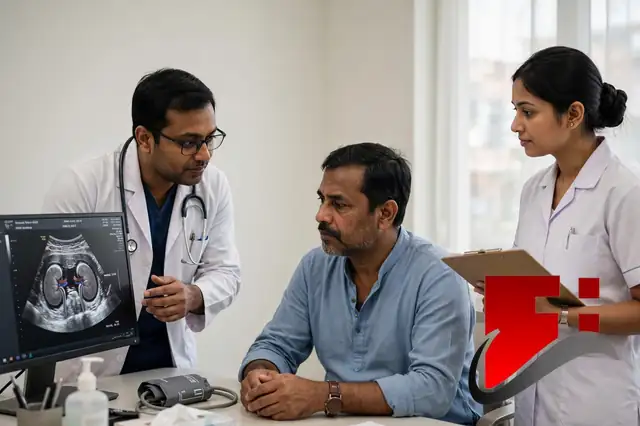
- Ultrasound: the first scan most doctors order. It has no radiation and shows stones and any swelling of the kidney. See our guide to abdominal ultrasound in Shibpur to know what this scan can detect.
- CT scan (non-contrast CT KUB): the most accurate test. It shows the exact size, number, and location of stones. It uses a small dose of radiation.
- X-ray KUB: shows mainly calcium stones; often used for follow-up after treatment.
These tests tell the doctor the stone's size and position, which decides the treatment.
Kidney Stone Treatment: What Are the Options?
Treatment depends on the stone's size, its location, your symptoms, and your general health. There are five main options:
1. Medicines and watchful waiting. For small stones, doctors often advise waiting while the stone passes naturally. You get painkillers for the pain, medicines that relax the ureter (such as tamsulosin) to help the stone slip through, antibiotics if there is infection, and advice to drink plenty of water. Most stones under 5 mm pass this way within a few weeks.
2. ESWL (shock wave lithotripsy). Sound waves generated outside the body are focused on the stone and break it into tiny pieces, which then pass out with urine. No cut, no scope, no stitches. It works best for kidney or upper ureter stones smaller than 2 cm and is usually a day-care procedure. As a general indication, ESWL in the Howrah region typically costs around Rs. 10,000 to Rs. 50,000 depending on the centre and the number of sessions.
3. URSL (ureteroscopy with laser). A thin scope is passed through the natural urine passage up to the stone in the ureter, and a laser breaks the stone into dust or small pieces. No cut on the body. This is the preferred option for ureter stones and is usually done as a day-care procedure.
4. RIRS (retrograde intrarenal surgery). A flexible scope with a laser reaches stones inside the kidney itself, usually stones between 8 and 15 mm. Like URSL, there is no outside cut, and recovery is quick.
5. PCNL (percutaneous nephrolithotomy). For large stones above 2 cm, the surgeon makes a small cut (about 1 cm) in the back, reaches the kidney directly, and removes or breaks the stone. Hospital stay is usually 1 to 2 days. As a general indication, PCNL in Howrah typically costs around Rs. 65,000 to Rs. 75,000 depending on the hospital.
All procedures are done under anaesthesia, so you feel no pain during the treatment itself.
Which Treatment Suits Your Stone?
As a rough guide:
- Below 5 mm: usually passes on its own with water and medicines.
- 5 to 10 mm: may pass, but often needs a procedure if pain continues, urine flow is blocked, or infection develops.
- Above 10 mm: usually needs ESWL, URSL, RIRS, or PCNL.
- Above 20 mm (2 cm): usually needs PCNL.
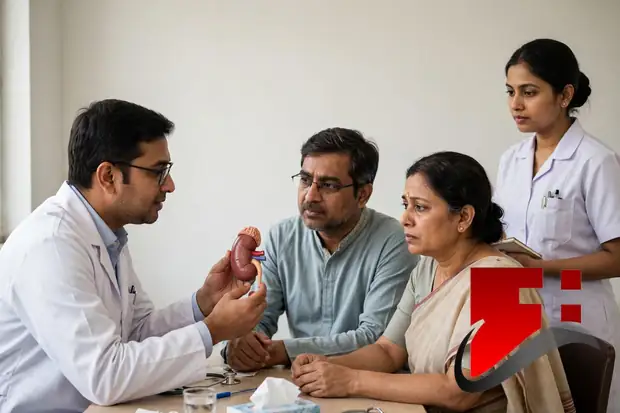
Your doctor makes the final call based on the stone's size and location, your kidney function, and whether infection is present. Never try to "wait it out" if you have fever with pain, cannot pass urine, vomit repeatedly, or have only one working kidney. Those situations need urgent care.
Diet Guide to Prevent Kidney Stones (Bengali Food Included)
Once you have had one stone, the chance of forming another is high unless habits change. Food and water are your strongest protection:
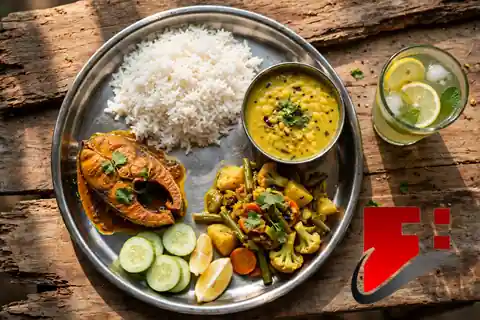
- Water, water, water. Drink 2.5 to 3 litres a day. Your urine should be light yellow, not dark. Keep a bottle at your desk, in your shop, or in your vehicle.
- Nimbu pani (lemon water). Citrus fruits contain citrate, which helps prevent stones. One glass of lemon water a day is a simple, cheap habit.
- Less salt. One teaspoon of salt a day is enough. Cut down on pickles, papad, packaged chips, and processed snacks.
- Moderate animal protein. You do not need to stop eating fish or meat, but avoid very large portions of red meat daily. Normal machher jhol portions are fine.
- Do not stop milk and curd. This surprises many people, but low calcium in food actually raises stone risk. Calcium from food binds oxalate in the gut and keeps it out of the urine.
- Oxalate balance. If your stones are the calcium oxalate type, do not eat huge amounts of palong shaak, nuts, or chocolate in one sitting. Eating them together with calcium-rich food (like curd) is safer than eating them alone.
- Less sugar and cold drinks. Sugary sodas raise stone risk clearly.
- Keep a healthy weight. Even modest weight loss lowers the risk of new stones.
What Happens If Kidney Stones Are Ignored?
A stone that blocks urine flow for weeks or months can quietly destroy the kidney. The blocked kidney swells, its filters get injured, and repeated infections set in. In long-neglected cases, the kidney can fail completely, and the patient may need lifelong dialysis. Our guide to dialysis in Howrah explains what that stage of kidney care involves.
Large stones do not dissolve on their own, and painkillers only mask the problem. Early treatment almost always means a smaller procedure, lower cost, and a fully protected kidney.
Kidney Stone Care at Lords Health Care, Howrah
At Lords Health Care in Shibpur, Howrah, kidney stone care starts with the right diagnosis. Our in-house diagnostic centre performs urine tests, blood tests including kidney function, ultrasound, and CT scans, so the exact size and location of your stone is known quickly and treatment planning starts the same day.
Lords has a dedicated Nephrology department for kidney-related medical care and evaluation, and our dialysis unit supports patients with advanced kidney disease, so complete kidney care is available under one roof.
Two related conditions deserve attention here. Diabetes and high blood pressure both damage the kidneys slowly over years, and both are common in stone patients. Read our guides to diabetes treatment in Howrah and hypertension treatment in Howrah to understand these connections.
After treatment, we keep you on a prevention plan: follow-up scans, urine and blood checks, and diet guidance, so the next stone never forms.
Frequently Asked Questions
Can kidney stones pass on their own?
Stones smaller than 5 mm usually pass with plenty of water and medicines within a few weeks. Larger stones usually need a procedure.
What is the fastest way to remove a kidney stone?
There is no instant home remedy. Small stones pass with water and medicines. Larger stones are removed with ESWL, laser procedures (URSL/RIRS), or PCNL, as your doctor advises based on the scan.
Is kidney stone surgery painful?
Modern stone procedures are done under anaesthesia, so there is no pain during treatment. Most patients go home the same day or the next day and return to normal work within a few days.
What foods should I avoid with kidney stones?
Cut extra salt, sugary drinks, and excess red meat. If your stones are calcium oxalate type, limit very large amounts of spinach, nuts, and chocolate. Keep drinking 2.5 to 3 litres of water daily.
Can kidney stones come back after treatment?
Yes. Without prevention, about half of all patients form another stone within 5 to 10 years. Enough water, the right diet, and follow-up tests cut this risk sharply.
When should I go to emergency for kidney stone pain?
Go at once if you have fever with flank pain, cannot pass urine, keep vomiting and cannot keep water down, the pain does not respond to painkillers, or you have only one working kidney.
Visit Lords Health Care for Kidney Stone Care in Howrah
Kidney stone pain does not have to control your life, and a small stone today should not become a damaged kidney tomorrow. Early diagnosis and the right treatment protect your kidneys for decades.
Visit Lords Health Care, Shibpur, Howrah for complete kidney stone evaluation and care. Call our toll-free helpline at 1800 309 0895 to book a consultation. Early treatment is the best protection your kidneys can get.